
CrimmigrAtIon: Does AI Belong in Immigration and Border Control?
- Krislyn Michel

- Mar 15
- 3 min read
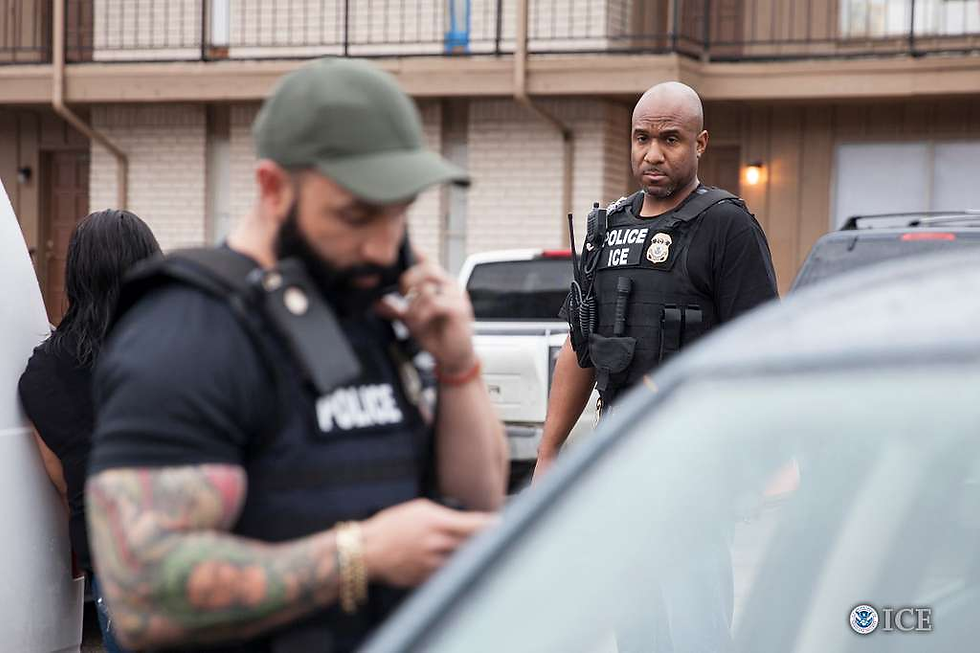
TikTok has inundated users with videos of United States Immigration and Customs Enforcement (ICE) agents ripping people out of their homes before promptly putting a phone to their faces, seemingly to capture their facial profiles and input information into a system. ICE recorded Alex Feinberg after he took a video of ICE agents at a Portland, Oregon, gas station. This occurrence with ICE is not limited to just the West Coast. A woman from Maine reported that ICE told her that they have created a database of “domestic terrorists.” Silent raids and immigration enforcement during the Obama administration targeted over 2.5 million people. The current administration has doubled the number of silent raids and mass neighborhood raids. The government has shifted its surveillance on immigrants, undocumented people, and individuals with Temporary Protected Status.
I believe that the data of all inhabitants in the U.S should be protected from surveillance unless authorities show sufficient rationale for due cause. In this context, policymakers should define protected data as biometrics, messages, contact information, financial information, geographic coordinates, search engine/social media activity, purchase history, and any existing data collected on immigrants and undocumented people. Additionally, the Fourth Amendment does not permit the latest actions of federal agencies. Government actors and agents can obtain warrants to authorize searches, seizures, and surveillance of encrypted digital information. But the government has proven itself to have the technology to circumvent historical constraints on law enforcement.
ICE has recently implemented a variety of new technologies into its surveillance arsenal. The federal agency has bought Clearview artificial intelligence (AI) facial recognition programs to track resistors, drones that can film protestors, and spyware that can remotely hack citizens’ devices. International governments previously used Clearview to surveil their respective political dissenters, various programs tracking targets over social media, and an eye-scanning app that can match an individual’s eye to public records in seconds without a warrant. Its Paragon program can tap discreetly into phones and collect data such as a device’s location, messages, and media. It is important to note that Rule 41 of the Federal Rules of Criminal Procedure and the All Writs Act do not appear to grant the government privileges and access to their private citizens’ data, even when law enforcement officers have obtained a warrant under the Fourth Amendment or other applicable law authorizing them to search and seize such data. Privacy has not eroded for both immigrants and citizens. So what happens when the current immigration policy in the United States is operating under a “Crimmigration” framework that degrades, subordinates, intimidates, and criminalizes people seeking to immigrate to the U.S.?
Data forecasting models that predict recidivism, criminality, or, in this case, undocumented immigrants are based on data in highly surveilled neighborhoods due to their racial population makeups, education and employment history, and other logics of systemic racism. For instance, a Massachusetts Institute of Technology study found that facial recognition algorithms from IBM and Microsoft had higher error rates for Black men than Black women and for White women than White men. Hence, software that agencies increasingly use in surveillance and policing contexts had errors at higher rates in some populations than others, contributing to overpolicing. Institutions can reproduce white privilege and the subordination of Black and Brown people in the racial order through intentionality and bias present in the foundational studies of these AI programs.
Overt government surveillance can inhibit lawful activities like free speech, free association, and other First Amendment rights that are crucial to democracy. This dynamic can instill a sense of defeat and powerlessness, with many of us resorting to digital resignation. However, it is important to note that these practices benefit from helpless users. Americans must recognize their autonomy and privilege to protect those who may lack the political power to tackle these social issues. Technologists and government officials must collectively acknowledge the past inequalities that have created this system. In fact, it is essential because in the eyes of an algorithm, a single data point is the only difference between a protected citizen and an unprotected immigrant.
Image Credit
Defense Visual Information Distribution Service, CC By-SA 2.0, via Dvids


Comments