
“America First” Policies Are Quietly Killing the United Nations
- Rachel Baron

- Mar 18
- 3 min read
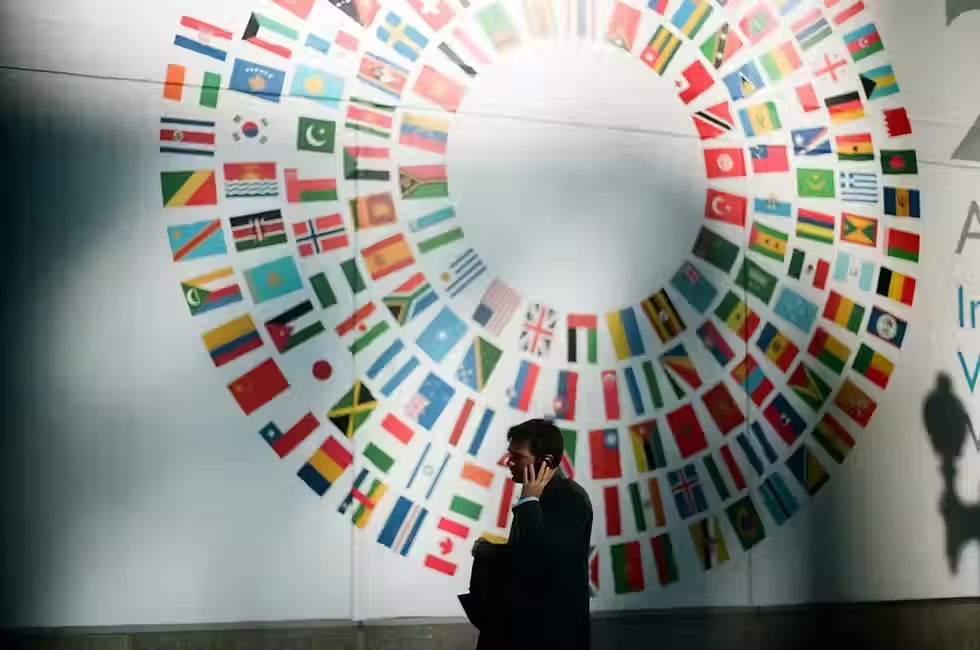
Emerging as a global superpower in the post-war era, the United States has long sought to secure its influence in international affairs. Working directly to secure the United Nations (UN) headquarters in New York City and a permanent seat on the Security Council, the American government has largely treated the UN as a means of extending political interests beyond its borders. Now that the political tide has turned towards “America First” policies, that power could be used to dismantle the entire international system.
On January 28, UN Secretary-General António Guterres warned UN member states of an “imminent financial collapse” due to ongoing unpaid dues. The US is refusing to pay nearly four billion dollars—two years’ worth of unpaid dues—clocking in at 95% of all missing payments to the UN. These funding shortfalls would cripple the fundamental institutions of the international systems, including General Assembly meetings, investigations, and humanitarian programs.
The US is no stranger to strategic manipulation of the UN. In the height of Cold War politics, the US launched inquiries into Soviet press freedom to weaken the Soviet Union's reputation. At the same time, the US evaded effective responsibility for its civil rights crisis by engineering an official definition of “minority” that was so exclusive it did not include African Americans. To be sure, American interests have (somewhat) changed since the Cold War, but their willingness to pull strings for personal gain remains.
The UN Charter sets the rules for dues payment, which consider a country’s gross national income, population size, debt, and other factors to determine the final price of membership. The US is the biggest funder at 22% of the budget, followed by China at 20% and Japan at 6.9%. What’s more, the UN is held to a strange rule that requires it to return all unspent dues by the end of the year, even if those dues have not been paid in the first place. If the US refuses to pay its share, not only will the UN be out almost a quarter of its total budget, but it will also owe the US money. As Guterres put it, the UN is “trapped in a Kafkaesque cycle, expected to give back cash that does not exist.”
The Trump administration’s budget request to Congress for “Contributions to International Organizations,” which includes the UN’s regular budget and specialized agencies, was a mere $263.8 million, 83% less than last year’s pre-recession $1.54 billion request. The money is intended to go only towards organizations that the administration believes it can benefit from, including programs in atomic energy and telecommunications. On the chopping block, one can find all peacekeeping missions and all voluntary funding, including Migration and Refugee Assistance, International Disaster Assistance, and Economic Support Fund.
What’s behind the refusal to pay? The Trump administration has provided only vague clues, citing “ongoing mission failures” for peacekeeping missions and concerns that the US’s dues are “disproportionately high.” In a December pledge of $2 billion for UN humanitarian programs (a $15 billion shortfall compared to 2022 under the Biden administration), the US warned the UN: “adapt or die.”
Without American dues, the UN may have no choice. The World Health Organization reported that 2025 funding cuts forced 6,700 health facilities to downsize or close, leaving 53 million people in crisis regions without medical care. The UN’s human rights office cannot fund investigations into ongoing human rights violations, the UN Population Fund has already closed mother and baby clinics in Afghanistan, and the World Food Program is limiting rations to Sudanese refugees.
Let’s not mince words. The “America First” policy is killing people. Concerns about the fairness of dues do not come close to matching the intensity and scale of crises that UN programs directly address. In combination with closed border policies, US withdrawal from the international system is effectively destabilizing living conditions for hundreds of millions of people, and then refusing to let them seek refuge.
So far, the death of the UN has been quiet and vague. Although US Ambassador Mike Waltz has stated that payments would begin, he has not commented on the amount of money to be sent. As children, refugees, and victims of international crimes are left with fewer resources than ever, the international system can do little but wait with bated breath.
Image Credit
Markus Krisetya, Unsplash License, via Unsplash


Comments